
Rebecca Lee Kunz and Cátia Chien: A Caldecott Conversation
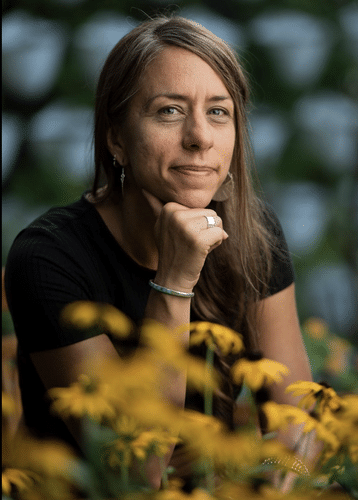
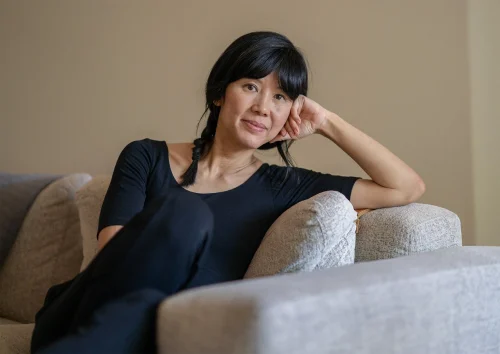
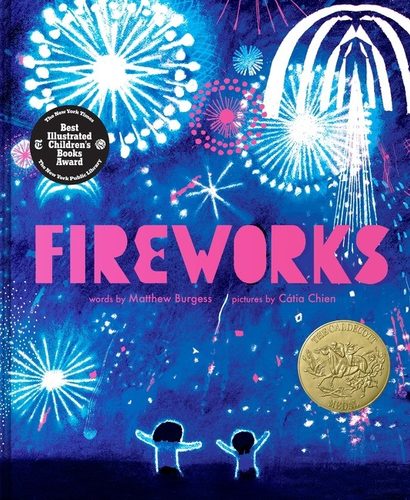
Today we have something special. Our past two Caldecott Medal winners, Rebecca Lee Kunz (Chooch Helped) and Cátia Chien (Fireworks) interviewing each other about their lives, work, and how the most prestigious award in picture books has changed their lives. Over the last couple months, Kunz and Chien traded questions and responses. Here is their conversation.

Rebecca Lee Kunz: Hi Cátia, this is fun. I’m excited to have a conversation with you! It was so nice to meet you this summer at the ALA Newbery/Caldecott Awards Banquet after you accepted your Caldecott Award. The interactive program you designed for the banquet was stunning. It was the talk of the ballroom! From the soft feel of the paper to the cut out paper engineering, it was quite a masterpiece. What was your process for designing that program?
ADVERTISEMENT
ADVERTISEMENT
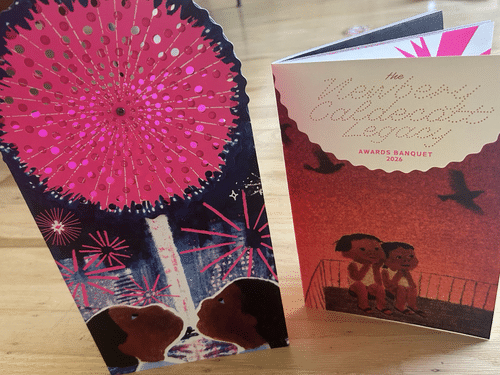
Cátia Chien: Hi Rebecca! Awww! Thank you. My immediate vision was a sea of moving fluro-pink fireworks, Pantone 806-C, lighting up the entire Banquet hall. Color can be such a powerful iconic way to mark a year.

I was so excited to start that within a few weeks of the announcement, I had reached out to a few paper engineers to see who was available and started to design. By the time I met with the team at Harper, I already had something to pitch, complete with some early prototype ideas/videos of the pop-up/kinetic component…and I was so relieved that Harper was fully onboard!
The actual nuts and bolts of designing the program looked like hundreds of long, tedious email exchanges, videos of me talking through my sketches, illustrations, print notes, texts and phone calls between myself and the Harper design team/printer/paper engineer: Can we print the blue so it is bluuuer? What is the page count and could we set up the gatefold appear right in the middle? What trim size would create the right impact? Is the rivet/grommet size on the pinwheel too tight and the right dimensions?
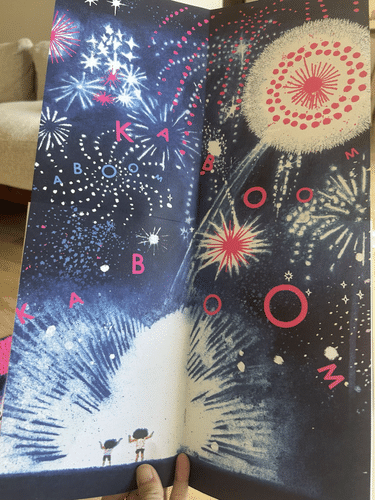
Which makes me think that maybe every artist gets a little obsessed when they love a project. What are your favorite details to obsess over in your creative practice?
Rebecca: How fun to hear about your process designing the program. Yes, I can definitely relate to your obsession with artistic details. I’m passionate about color and beautiful paper. Textured handmade paper is my favorite. I love how the deckled edge of handmade paper is uneven and organic. Each piece is unique, like nature. I’m infatuated with earth tones; colors that are found in the setting sun, or in the simple dirt underfoot. If you’ve ever looked at dirt under a microscope, it’s actually not that simple! It has so many unexpected variations in tone and hue. Similarly, when you look at adobe architecture, and if you blur your eyes and look at the New Mexico landscape, you might just see a sea of brown and tan. But when you take a further look, you start to notice many understated earth tones. Mother nature is really my favorite artist. I’m just always trying to keep up.
The first year after winning the Caldecott can be wild. How has this year been for you, Cátia? Are you able to keep up with new opportunities and events in addition to your normal workload? How has it been to keep up with your inbox?
Cátia: Oh the dreaded inbox! But it is after all a celebration of art and I didn’t want to
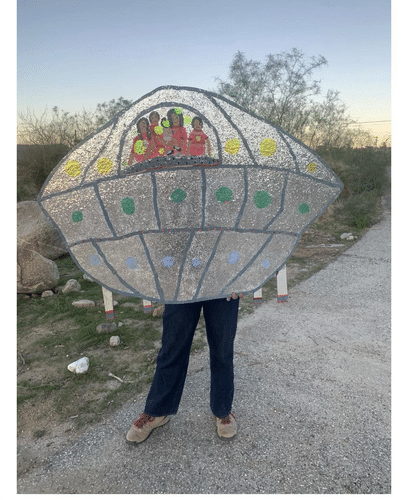
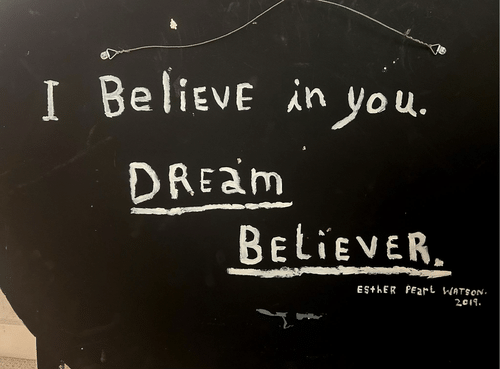
forget to celebrate. When I got the announcement I bought a painting that I’ve been coveting for a while by Esther Pearl Watson. It is of a bedazzled space ship with four women and a baby in it. On the back it reads “I Believe in you Dream Believer.” Oh I love it so much!
And another thing to celebrate: back in 2020 I started working on A Thousand Worlds which is a free online bookshelf listing picture books specifically by BIPOC creators, curated by BIPOC industry leaders. I wanted to find a way to contribute to the amplification of marginalized voices.
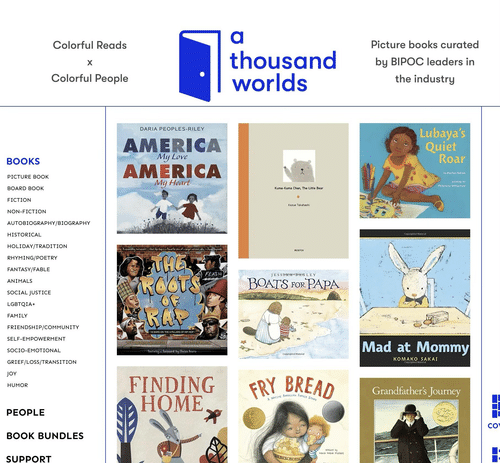
I never could have dreamt that six years later I would get to visit schools in Chinatown, whose student population is mostly Asian, as the Caldecott medalist. A moment where kids got to not only see themselves in Fireworks but also meet a Caldecott medalist who looks like them. This is one of those moments that brings this win home for me. Everything else is just part of the deal — the admin work, the business but it’s good to keep it in perspective.
Can you share a personal story or a piece of art that has special significance to you during your Caldecott year?
Rebecca: 2025 was such an exciting year; exhilarating, and very stressful. There were all the interviews and projects due from being the Caldecott awardee (like designing the ALA READ poster).
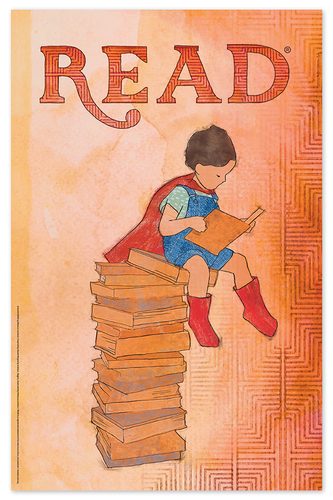
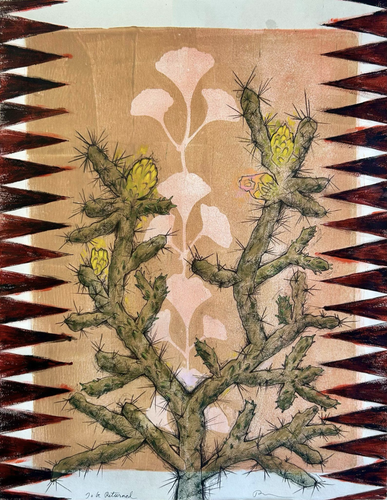
And, I’m so grateful for all of those opportunities. Then, on the way home from a trip to Oaxaca, we got stuck in Oaxaca City from delayed flights, and I wasn’t sure if I would make it back in time for the Caldecott/Newbery Awards Banquet. Talk about stress! But, I did make it to the banquet and it was such a beautiful celebration. I have never felt that kind of love. The next month I had a previously scheduled original art show which focused on bringing awareness to a local endangered species called the Cholla cactus. THEN I had my 50th birthday in December. Phew, what a whirlwind of a year! Unforgettable.
Here’s a mixed media Monotype/Gouache painting from my 2025 Cholla exhibition, titled To Be Returned:
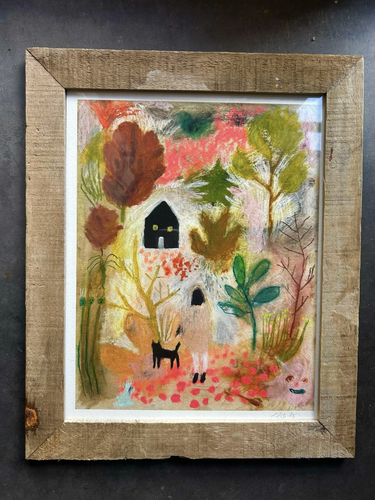
But during that year, I bought this piece of art from the artist Michael McGrath. I love his whimsy and use of color:
What is your work-life balance like? I know you are a mom. How do you balance that responsibility with your career? Do you have a consistent schedule and regimen, or is each day and week different?
Catia: Ha! I love being a mom and I love being an artist. One thing I’ve learned to do that has helped with work/life balance is lean into the joyof calendars, spreadsheets and meal plans. My husband and I have five different calendars, documents and spreadsheets that organize our family life. I’m not a type A person and this sounds intense to me too, but it is actually what makes it possible to have some sense of ease.
It’s the contradiction of life. I find that the more clear and efficient our organizational systems are the more I can completely shut it out and switch to creative time where I don’t have to worry about getting out of my pajamas if I don’t have to and I can act like schedules don’t exist at all. It is not about perfection or a do-it-all mentality. I will sometimes only have work on my calendar because I’m traveling so much or mostly family time when I am dragging my feet on a deadline. But it helps to have a clear picture of where it all fits into the bigger scheme of things.
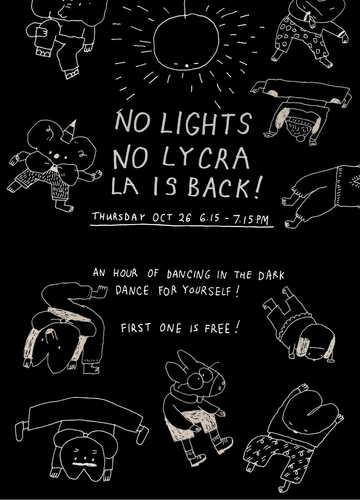
What also helps me ground myself is allotting time for something I love to do just for me, like dancing. When I lived in NY with my family I loved going to NLNL (No lights, No lycra), which are 1hr weekly pop up dance sessions that happen in the dark with no teachers, just a big empty space with tiny lasers/lights in the basement of a church in NY in Greenpoint. It’s essentially a dance movement that started in Melbourne and it is now everywhere in the world run by individuals who want to carve out a space for all bodies to feel safe to dance. It is so fun and I’m determined to start one here for families with kids so we can all shake off the day and decompress! Do you have a favorite way to decompress and shake off the day?
Rebecca: By about mid afternoon each day I start to feel really antsy. The best remedy for this is always movement. When I can pry myself off my chair and exercise I always feel better. But, if I’m on a tight deadline sometimes exercise has to wait. I love jumping rope, dancing, and am also a runner. Movement is so important to my overall well-being and it’s one of the only things that helps me to decompress. I feel a surge of creativity when I’m exercising, and have cultivated a practice of summoning inspiration at this time. I also love curling up on the couch with my daughters, each with a book in hand, with our dog, Nalii, at our feet. It’s just the best.
Here’s Nalii:
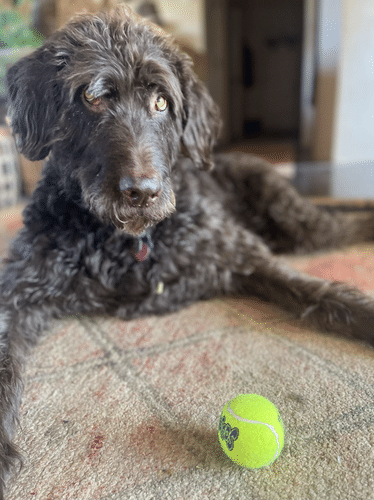
Cátia: awwww
Rebecca: I often wonder what the book-making process is like for other illustrators. I know it’s a bit different for each project. How much input do you typically get from the author (when it’s not yourself) and/or editor of a book, with their desires for the artwork? How has the process been for you working as the hired artist for an author? Do you find it intimidating or exhilarating to interpret another person’s story through your art?
Catia: Authors I’ve worked with who I love, like Matthew Burgess and Joanna Ho are some of my favorite people. But, and this might be controversial, I don’t find it intimidating because I only work on a story that speaks to me in some way and the author is not part of that equation.
To me, the story neither gives or seeks approval. It just wants to flow through the right vessel to complete itself. So it’s not me proving my worth as much as it is just whether or not I feel I can bring something interesting to the story and would like to discover
what that thing is. It is a feeling. This also means that I don’t do art notes. If an author needs art notes for themselves and the editor to anchor the story that is fine. But I ignore them most of the time…Not because I’m being difficult, but truly because it can limit what might be possible. If I read the art notes then I might just be so preoccupied at pleasing the author’s vision that it will be hard for me to imagine out of that box.
Another point is I don’t see this as a “hired artist for an author” situation at all. I think it is an equal creative partnership but it takes a lot of trust to hand off something to another creator and trust in their voice too.
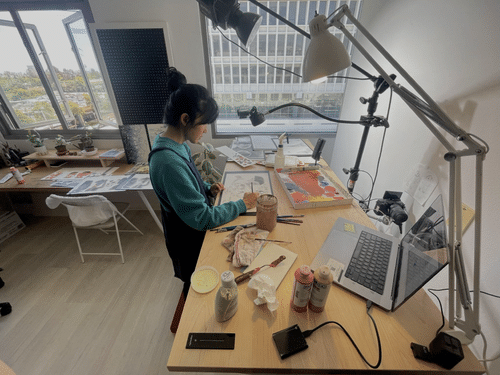
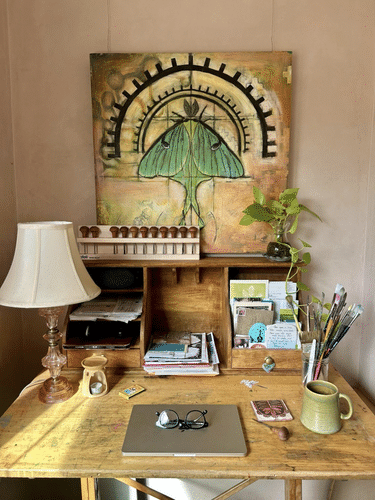
I’m curious what your space looks like and how has creating picture books changed your fine art practice? And what is your process like in working with authors?
Rebecca: I couldn’t agree with you more about the equal creative partnership between author and illustrator. Similar to you, I’ve only worked on stories that I love, with authors that I respect. I’ve been lucky to work with an editor and publisher who also give me creative freedom. I love how the art director is also like a teammate, ready to be a thought partner or assist with the artistic side of bookmaking. When I was new to the field, my first art director taught me so much about making art for children’s books. Because I had mostly made my own original art up until that point, there was a big learning curve. That first year of making picture book art was a time of enormous growth. That said, there are a lot of crossovers between my painting and printmaking background and picture book illustration. When learning to create art for books, my goal was to translate the style that I had developed over years to a picture book format.
I still make art that’s unrelated to books, but I’m not able to spend as much time each week on that. I now spend more time illustrating books than I do on other art. My schedule is always evolving, but my goal is to find balance between the two. They are equally important to me, and surprisingly, they inform each other a lot.
My work space is sometimes my drafting table, sometimes my easel, and sometimes my kitchen table. And then, sometimes my kitchen table is my kids’ art space. It’s amazing how many times a kitchen table can be transformed in one day! Someday I hope to build a separate studio where I have space for everything in one place. But, until then, I’m making due with what I’ve got. Being scrappy is an important life skill — ha!
Here’s my drafting table work space:
When people learn that you are a Caldecott medalist, what is their typical reaction? Do you find most people understand the significance of the award, or are some people not aware of its meaning?
ADVERTISEMENT
ADVERTISEMENT
Catia: Well when my son learned that I won the Caldecott he was shocked. He is 8 and he had given Fireworks a 1 star out of 5 because in his own words – “no dragons.” I had failed in all of my attempts at impressing him with the pyrotechnics of a well imagined pop and kaboom! But a few days after the announcement of the Caldecott, which included me explaining to him what it was and what it meant, I found him sneaking into his bookshelf to take a second look at Fireworks. “Hmmmmmm…not… bad?” I caught him saying to himself. It made me laugh so much. He is one of my favorite artists.
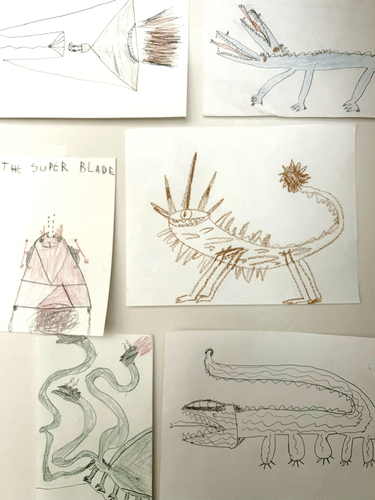
Rebecca: Your son’s artwork is brilliant! I can see why he is one of your favorite artists. Kids’ art is just the best, isn’t it? When they are young they’re not inhibited or self-conscious yet; their art comes straight from their heart, unfiltered. Ahh, to be a child again.
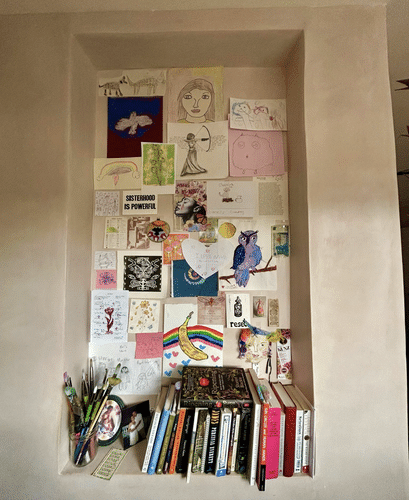
This wall next to my workspace is like my bulletin board- where I have a rotating display of mail, paper ephemera, and art from people I love. A lot of it is my kids’:
Catia: Ok Rebecca, last question: What do you think has changed for you with a little more distance and time to reflect on your year?
Rebecca: Well, to begin with, I am traveling more than ever. I now spend time speaking, doing book readings, and talking to students about art and illustration. I continue to run my business, Tree of Life Studio, and I am busy trying to keep up with that, making art, and making books. It’s a big messy creative life, but I love it. I’m really grateful to do what I love full time.

Thank you Rebecca Lee Kunz and Cátia Chien for taking part. Thank you Angela Melamud and Tracy Miracle for making it happen.
If you liked this Caldecott Conversation, you’ll like these as well:
Matthew Cordell and Sophie Blackall: A Caldecott Conversation
Javaka Steptoe and Matthew Cordell: A Caldecott Conversation
Chris Raschka and Jon Klassen: A Caldecott Conversation
Erin E. Stead and Chris Raschka: A Caldecott Conversation
Jerry Pinkney and Erin E. Stead: A Caldecott Conversation

Join 2,500+ librarians! Subscribe to my newsletter on Substack
Filed under: Uncategorized

About Travis Jonker
Travis Jonker is an elementary school librarian in Michigan. He writes reviews (and the occasional article or two) for School Library Journal and is a member of the 2014 Caldecott committee. You can email Travis at scopenotes@gmail.com, or follow him on Twitter: @100scopenotes.
ADVERTISEMENT
ADVERTISEMENT
SLJ Blog Network
Fuse 8 n’ Kate: McElligot’s Pool by Dr. Seuss
Undercover Monster | Extended Preview
Friday Fun: A Last Line Quiz
From Policy Ask to Public Voice: Five Layers of Writing to Advance School Library Policy
Dyslexia Awareness Month Wrap Up: Dyslexia Kits and a Soon to Graduate Senior
Luke Pearson Made a Picture Book!
ADVERTISEMENT